




|
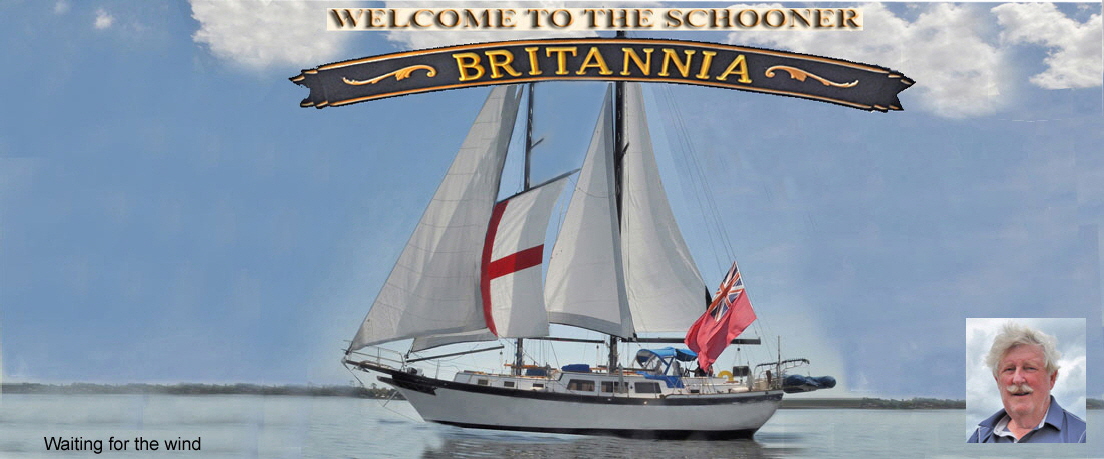
She is a center cockpit cutter rigged cruising ketch of fourteen foot beam, with a traditional long keel, drawing about six feet and displacing some twenty tons. She also has a simulated planked hull which fools some into asking if she is made of wood.
Here is a picture of what she looked like when I took delivery in Fort Lauderdale.
I had searched for a long time, trying to find an ideal boat, since I really wanted a schooner. The only one I ever found suitable was another Down Easter 45, but it slipped though my fingers at the last minute of purchase. The reason I wanted a schooner was because I really wanted a Brigantine, which for the uninitiated is a schooner with one or two square sails on the foremast. To me, a Brigantine is the ideal cruising rig, being capable of hauling tolerably close to the wind in an emergency, (although not as high as with a 85 hp engine), having first class reaching capabilities and unbelievable down wind sailing using the square sails.
I have done a bit with square sails, and I’m aware of their advantages and disadvantages. Their considerable advantage comes into its own when the wind is from either stern quarter, or directly behind. Anyone with a Bermudan rigged sailboat, or even a gaffer for that matter, knows the necessity and difficulty of holding a steady course in these wind conditions, especially if a big sea is also running from astern. With square sails correctly braced and filling the boat becomes very stable and there is absolutely no fear of gybing or broaching. Indeed the course can vary considerably, by as much as 30/40 degrees, and a novice helmsman or autopilot will have little difficulty in keeping the ship on a steady downwind run.
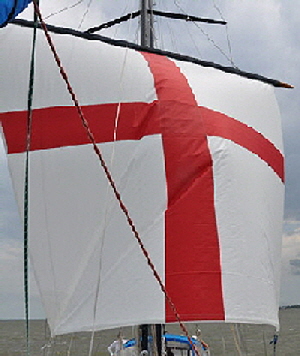
There is however also a considerable disadvantage in a conventional square sail set on a yard - handling the sail(s). This single problem precludes the use of square sails on all but large crewed private yachts, or sail training ships with loads of young people willing to scale the ratlines and shuffle out along the foot-ropes to claw the canvas into submission onto the yard, (and I know from where I speak). Either way it is a very dangerous and skilled operation - but what if you could safely furl the sail without a single person having to go aloft, then unfurl it when you needed it again, all from the safety of the cockpit? If you are interested, or simply intrigued in this proposition click here
There were other reasons I bought this boat - it has a lot of teak internal woodwork, and I like working in wood. It is a medium which is quite easy to alter, as opposed to the glass fiber bulkheads and prebuilt sections used nowadays
Of course, there were also a number of things I did not like, particularly some aspects of the internal layout, like the wash basin in the aft bedroom, instead of the bathroom, the full width lazarette which considerably restricted space in the aft cabin bed, the 3/4 size bathtub which is neither one thing nor the other, and the scruffy little toilets. However, I knew all these things could be changed, and I have already altered many of them. However, the big modification is now in progress - converting the rig from a ketch to a schooner, see RE-RIGGING.
I will be publishing updated photographs more or less weekly. So here is the ongoing saga of the transmogrification of an old(ish) sailboat, into a modern comfortable cruising vessel.
Additions and remodeling projects:
Installation of two 16,500 BTU reverse cycle air conditioning units.
Installation of a full size hot-tub bath in the aft bathroom.
Remodeling the aft cabin and bathroom.
Remodeling the forward bathroom.
Making the yard and square sail.
Redesigning the internal layout.
Installing a dinghy hoist.
Rerigging from Ketch to Schooner
Galley additions.
Items for sale
ROGER HUGHES JANUARY 2012 |