

 The chain locker in Britannia's bow was totally inadequate for the 250-feet of 3/8-inch chain which I considered a minimum for my 24-ton boat.
Every time we weighed anchor - even when only part of the rode had been laid - the chain always piled up in the locker and jammed the windlass. Someone then had to scramble over the forward cabin bunks, open the locker's equally inadequate little door, and push the pile of wet chain to one side to allow the remainder to feed in. Sometimes this had to be done twice and was very tiresome especially when my wife and I were the only two aboard.
The reason the chain would not self-stow was because the locker was in the steep vee of the bow and the chain had no room to spread as it piled up. There was nothing that could be done to enlarge this space but every time it happened I swore I would somehow try to re-route the chain into one of the large compartments under the fo'c'sle bunks. These were easily big enough to accommodate all the chain and were only used for storage of spare pipes and lines we hardly ever used
If relocating the chain could be achieved there would be an additional advantage: 250-feet of 3/8-inch chain weighs about 420Lbs, therefore the further aft the chain could be stowed the lighter the bow would become and it is always better to keep weight on a 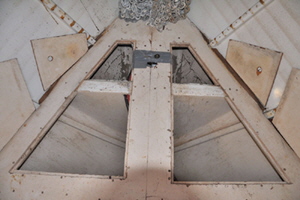 boat’s extremity to a minimum - at both ends to reduce pitching.
There were two large compartments under the forward cabin bunks, the after-most one being the widest and deepest. This was 33-inches deep and 21-inches fore and aft and spanned the width of the hull. It also had a solid glass fiber floor which would be ideal since the chain could spread better on the wider flat surface. The question was, how to direct the chain into this larger compartment? It is four feet further back from the existing locker and I couldn't run a tube directly from the navel hole into the new locker because it would pass straight through the middle of the vee berth.
When I installed a new Maxwell electric windlass to replace the old manually operated one I positioned it on top of the bowsprit. The chain then ran smoothly from the bow roller round the windlass gypsy and down through the navel-pipe - that's the hole leading from the deck into the chain locker. The only route for the chain was down through the existing locker, around an almost 90° degree curve and along a tube under the bunks. But although the locker was more than big enough would the chain then continuously feed under its own weight over this distance?
The chain easily rolled off the wildcat and down into the original chain locker because it was a vertical drop. But to route it into the new locker it then needed to pass through a curved pipe and travel a further 45-inches along a tube to finally fall into the center of the new compartment. The long tube would therefore need to be angled downward enough to help overcome friction as the chain slid along it, then it would need to have a deep enough fall at the end for the weight to haul the rest of the chain in a continuous automatic feed. I had no idea what sort of slope would be needed or how much fall the chain needed to continuously drag itself through this pipework. Nor could I experiment with the angle of the pipes in the actual fo'c'sle because the 2-inch diameter tube had to pass through a bulkhead between the two compartments and I didn't know where to drill the large hole.
 There was only one way I could think of to determine a suitable angle. I assembled a crude mockup using some 2-inch diameter plastic conduit pipe that is normally used for plumbing in houses. It is amazingly strong stuff with a wall thickness over 1/8-inch, (actually 0.162), and very rigid when connected together. I bought it from our local hardware store for only $10.15, including a curved pipe then I used my work-bench and a step-ladder to hold the tubes. The down-pipe which would pass through the old locker was 34-inches long and the pipe to carry the chain into the center of the new compartment was 45-inches long. My mockup all looked very amateurish but it gave me an idea of what sort of angle was needed. For my test I used 50-feet of chain out of the aft anchor locker that was the the same size as the bow chain. I fed it through the tubes and after a bit of adjustment I found a minimum slope of approximately 10° degrees allowed the chain to run continuously as I fed it into the top pipe. I took measurements and transferred them to where the hole needed to be cut in the bulkhead between the two compartments to carry the pipe.
INSTALLING THE NEW PIPES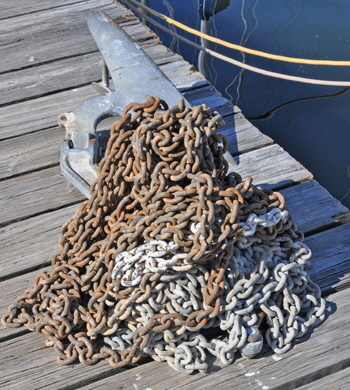 Before I could install anything I had to haul all the chain off the boat and pile it up on the dock to give a clear working space.
Luckily the plywood base of the bunks had only been screwed to the beam structure underneath, so I removed the complete starboard side section that gave me much more space to work in. I marked where the hole needed to be in the intervening bulkhead and cut a hole using a 2½-inch hole cutter. I also had to greatly enlarge the tiny drain hole in the bottom of the original chain locker to be able to position the 2-inch diameter curved pipe. I didn't want this to show above the 6-inch bed foam so I cut it as low as possible.
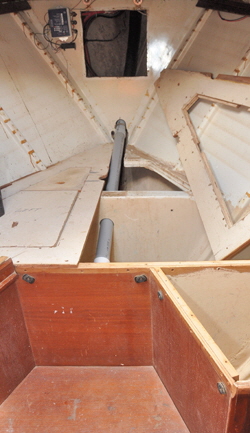 I found it impossible to use solid pipe to connect the navel hole on the deck to the curved pipe below because the angles were completely misaligned. I bought a length of flexible truck fuel filler tubing from a truck parts store which was just right with a 2-inch internal diameter. I was able to join it directly to the 2-inch round flange on the navel pipe using a hose clip then I clamped the other end to the curved pipe at the bottom of the locker, giving the chain a perfect lead into the curved pipe. When it was all finally assembled I had a continuous waterproof tube from the navel-hole on deck straight through the old locker, round the curve and along the pipe into my new chain locker, a total length of 86-inches. Having installed all the tubing I still couldn't be absolutely certain if all this effort would actually eliminate the chain backing-up. I had used only a small length of chain in my simulation test but as a much longer length piled up in the locker the distance it had to fall would reduce. So would the fall still be enough to continue to self-feed right to the last link? There was only one way to find out.
As I assembled the pipes I ran a 1/4-inch rope through the middle to enable me to pull the first links through the tubes. I passed this line over the windlass wildcat and tied it to the first link then easily pulled the chain through the complete tube and shackled it to a hefty eye-bolt I screwed through the locker bulkhead. The maximum fall from the end of the pipe to the bottom of the new locker was 27-inches and the first lengths of chain landed right in the center of the locker.
 The base of the new compartment was flat and I hoped this would allow the chain to collapse itself from a larger pyramid pile. Thankfully this proved to be the case and all the chain ran into the new locker on its own - every last link. Wow! I fancied I even saw a smile from the windlass gypsy that would no longer have its teeth almost pulled out every time the chain jammed.
In the original layout seawater coming in on the chain - that can be quite substantial especially with a full-length rode - drained down the slope of the bow then aft into the bilge. The boat manufacturers also put two drain holes in the bottom of the flat compartment floor that drained into the bilge channel beneath.
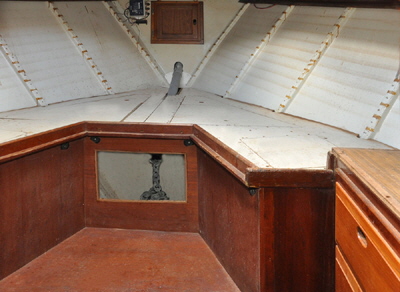 I was confident this re-directing had solved the vexing anchor stowing problem but you never know on boats. Murphy is always just around the corner so I made a further alteration. If the chain ever banked up and jammed again the only way to knock the pile over would be to move the bulky bed foam with all the sheets, covers, and pillows, lift the locker board and reach down into the deep space to knock the pile over. This would be just as much of a nuisance as before, however, the rear of the new compartment formed the back of the removable seat between the vee berths. I therfore cut a large aperture in this panel that offered instant access to the chain compartment without having to disturb anything. This access hole does not need a door either because the seat back cushion covers it. It just needed trim around the exposed edges.
When I put the foam mattress back I did have to slice a taper out of the bottom of the foam, to eliminate a bump over the curved pipe, that is now completely undetectable when the bed is made.
 Britannia now has a totally self-feeding anchor chain system that has never failed thus far - even on the rare occasions I have anchored using all the rode.
I did receive a complaint though from the first guests who slept in the fo'c'sle. They said it sounded like an earthquake as we weighed anchor one morning while they were still asleep. But I didn't pay much notice because they should have been on deck helping as we got underway. On the plus side Britannia's bow came up about 1 1/2-inches due to shifting the heavy chain further aft. This might not sound much but it’s the reduced inertia that matters as the bow plows into head seas.
If your boat’s chain locker won't accept all the chain without having to knock the pile over, and you manage to fix it in this way it will come as a wonderful relief every time you weigh anchor, and all the chain mysteriously disappears on its own.