

 The two levels of vinyl-coated wire lifelines on Britannia were well past their prime. Sections of the vinyl-coating had faded into a dull brown and long sections had cracked exposing the wire, and many of the chrome fittings had lost their luster.
  If I ran my hand along an exposed section it often drew blood. The lines simply had to be replaced not only for safety and to restore a smooth surface but also for appearance.
Lifelines are primarily intended to stop someone falling overboard, so strength must be the first consideration in any replacement. But this raises another important question: how does a person who happens to fall overboard get back on board either through or over the lifelines? Thinking about this brought back memories of an incident when I was chartering my boat in the Mediterranean.
MAN OVERBOARD
I once actually had to perform a man overboard retrieval, (actually it was a woman), but thankfully not in dire emergency conditions because we were anchored. A very overweight lady foolishly climbed down the boarding ladder with a wool poncho over her costume and it didn't take but a few minutes for the poncho to become waterlogged and she was in trouble. She was unable to get a foot on even the lowest rung of the boarding ladder, and no chance of climbing up. She jettisoned the weighty poncho and clung to the ladder while I thought how to get her back on board.
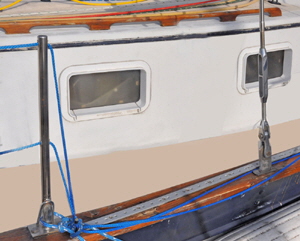 When rescue is from alongside lowering the lifelines makes the operation so much easier. This lady was much too big and heavy to physically pull up the side of the boat, so I rigged the main boom with a snatch-block and a line with a loop big enough to pass around her back and under her arms and the bitter-end led to the windlass warping drum. As I set this up my wife released the pelican hooks on both wire lifelines and we were able to lower them between two stanchions. The hapless lady was then hoisted over both lines to plop on the deck like a landed fish. The only thing she suffered, apart from her dignity, was temporary bruising on her arms and back caused by the rope. This incident showed me how tricky it can be to get someone back on board, yet on a flat sea it could hardly be classed as a life-threatening emergency.
A real emergency, like a sinking might require launching Britannia’s heavy liferaft from the deck. It is an eight-man ocean raft which weighs over 140Lbs and sits in a canister in the center of the deck. I have great difficulty moving it on my own whenever I want to scrub the deck, and it is too big to slide between the lifelines that would definitely need to be released or cut to allow it to be shoved over the bulwarks. The same problem might occur in man-handling a heavy dinghy stowed on deck that needed to be launched in a hurry.
The permutations for confusion if someone actually does go overboard are considerable and hardly predictable. It is therefore only sensible to take as many precautions as possible to make retrieval easier. It is to be hoped that under conditions where a man-overboard might occur everyone would be wearing lifejackets that would make hoisting someone back on board much easier if a line could be tied to a harness, but lowering the lifelines would make any rescue much easier.
LIFELINES:
 Most lifelines have pelican hooks at one end that can be released to slack the lines. Britannia’s were the old style with a locking ring over the release lever, but when the wires were tight it was very difficult to pry the ring back over the latch by hand and pliers were necessary to squeeze the latch. A new type of pelican hook from CS Johnson Inc. has a pin like a snap-shackle that releases the hook even with the lines in maximum tension. Lines can also be released by unwinding the turnbuckle at the other end but if the line is tight that too can be difficult to unwind by hand. I had removed all the locking
  nuts on my turnbuckles because they also need pliers or wrenches to release them, and in a dire emergency speed may be critical. CS Johnson has a neat adjustment tool that fits in the center small hole of a tubular turnbuckle and is much better than pliers or the bit of wire I have used for years. If for any reason lines cannot be released a final option would be to cut the wire but cutting 3/16-inch steel wire requires long-handled wire cutters, that first have to be found and brought up on deck. This whole process would be considerably easier if the lifelines were rope that could easily be cut - but would rope be strong enough?
ALTERNATIVES:
I’m sure that most boat owners will have heard about the super-strong rope known collectively under the trade-name Dyneema®, but sold under various names by rope-makers. The technical name is Ultra-high-molecular-weight-polyethylene (UHMWPE) - quite a mouthful.
Since I was going to replace the wires anyway I decided to look at the pros’ and cons’ of wire and rope. Maybe there was now a better way than old fashioned plastic covered wire? There is certainly more than one way to replace warn lifelines and the opinions expressed here are entirely my own, and since we are considering life-lines, no responsibility is accepted for any adverse consequences.
Whatever the lifelines are made from strength is obviously important, yet I couldn't find any manufacturer who gave the strength of their rope or wire when used as lifelines. All I could find is “tensile strength,” or “working load” and no account is taken for stanchions that are integral to any boat’s lifeline system. Whatever I decided to use to replace my worn lifelines had also to be no thicker than 3/8-inch diameter, to be able to pass through the 7/16-inch holes in the stanchions.
CHOICES OF LIFELINES
WIRE: Uncoated wire can become untouchably hot in the Florida sunshine, and I don’t like gripping thin wire with bare hands anyway, so I didn’t even consider that. Vinyl coated wire is very commonly fitted by boat manufacturers and also sold through after-market suppliers. It looks smart when it’s new, but over time water can enter at the ends that eventually causes corrosion that may not be visible under the plastic covering. Wire is however very strong and 3/16-inch 7x7 strand wire has a working load of 3700Lbs.
ROPE: When talking about rope here I mean 1/4-inch Dyneema that is considerably stronger than double braided line and even stainless wire of the same thickness. For example: 1/4-inch 7x7 316 stainless steel wire has a tensile strength of about 4800Lbs and the same thickness in double-braided line is roughly 4250Lbs. But 12 strand Dyneema has an amazing tensile strength of between 8000 and 12,000Lbs.
Note: Dyneema strength figures vary between manufacturers. Even so, the potential for substituting Dyneema for many lines on a sailboat now becomes a viable possibility, including lifelines. What puts many boat owners off Dyneema is its cost, which in most retail outlets is about twice that of comparable size double-braided rope or wire. However, Miami Cordage Inc. a rope maker hidden in the industrial depths of Miami, Florida, are considerably cheaper than the regular retail outlets that most boaters, - including me - have allways used. Most owners will not have heard of them because nearly all their product goes to the United States Navy and Coast Guard, and other industrial outlets. Yet they make every conceivable type of rope from old style three strand Manila to 12 strand Dyneema that they call “Ironlite,” and they sell over the counter and mail order internationally.
OTHER CONSIDERATIONS.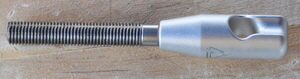 End fittings: A not insignificant additional cost in replacing existing lines are the fittings needed on each end, especially if new turnbuckles and pelican hooks are needed. I thought hard about reusing my old end fittings that would have reduced the cost of this project considerably, but I finally decided to do the job properly and buy new splice-line rope fittings from CS Johnson, including their beautifully crafted quick-release pelican hooks.
Stretch (creep): Once tightened bar-tight with the turnbuckles wire does not stretch further. Dyneema only stretches about 1%, but once stretched does not move much after that. Dyneema can also be set up as bar-tight as wire.
Chafe: All lines are subject to chafe by sheets, lines, fender lines, etc. and where they pass through stanchions. Britannia’s stanchions have a flared tube in each through hole that minimizes chafe at those points.
Cleaning the lines: White vinyl-coated wire can simply be wiped with a rag and some bleach now and again but the vinyl still fades over time. Dyneema has a shiny slightly slippery texture that can be cleaned with soap and water and available in many colors. All makers claim that their Dyneema is UV protected.
INSTALLING NEW LIFELINES: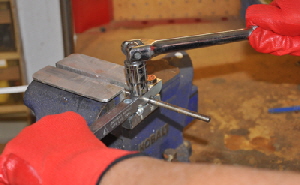 WIRE: I needed roughly 150-feet of wire and sixteen threaded ends to replace my old wire lines, along with at least three new turnbuckles to replace the worn out ones. The conventional method of attaching threaded ends to wire is to compress, (swage) the fitting to the wire. This can be done using a hand-swager tool offered by most rigging suppliers but if you have a lot to do it is very tedious. First the vinyl coating has to be cut back a couple of inches exposing the wire, this in itself is not easy and best done in a sturdy vice with a sharp box cutter blade. Then five crimps are recommended on each fitting using a wrench to tighten the bolts and squeeze the swager together. I needed 16 fittings, that’s 80 crimps and even if each swage only took five minutes it would still take nearly 7 hours! Also, hand-swaging only produces 65% of the strength of the wire but a hydraulic crimping machine increases this to 85%.
With this hand-swaging reality I decided to ask for a quote from West Marine rigging services for vinyl-covered wire with end fittings professionally attached. The price was $784.00 just for the wire! Boats with wire lifelines should also have a good quality wire cutter on board to chop the wire in an emergency.
ROPE: Dyneema can be attached to existing end fittings with either a splice or even a knot, but CS Johnson have special rope end attachments called “Splice-Line” fittings designed to attach Dyneema to all types of fittings like turnbuckles and pelican hooks. 12 strand Dyneema is hollow with no center core and considerably easier to eye-splice, unlike the complicated—at least for me—Class 1 reverse-tuck procedure for splicing double-braided line. Dyneema splicing is made considerably easier using a special 14-inch long splicing wand from Brion Toss rigging. This fid enables the tapered end to be pulled through the core, instead of pushing it with a conventional fid. With sixteen splices to make I was very thankful to have one of these neat tools that can also be used for other rope work. www.rigging@briontoss.com
Miami Cordage make Ironlite in many colors, including solid blue that would nicely match Britannia’s royal blue color scheme.
ADVANTAGES OF DYNEEMA AGAINST WIRE:

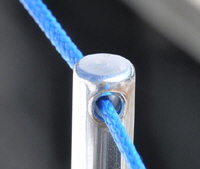 1/4-inch Dyneema is much stronger than 3/16-inch wire. Dyneema 8000Lbs, wire 3700Lbs.
Dyneema is not subject to corrosion or affected by rain or seawater and is easily inspected for chafe and it also floats. Any section of a rope lifeline can easily be lowered between stanchions because the line slides through the stanchions and bends easily. Wire does not slide or bend very easily.
If necessary, rope lifelines can be cut with a sharp knife. Wire needs a long-handled wire cutter.
Rope lifelines can be replaced without tools or fittings even on passage. A spare 50’ foot length of 1/4-inch Dyneema is much easier to store than the same length of wire.
Dyneema is very much lighter than wire rope. My old wire lines weighed 13Lbs. The same length of Dyneema rope weighed only 2.4Lbs.
Dyneema is hollow with no center core and very much easier to splice than double braided line.
 I therefore decided to replace my old wire lifelines, top and bottom with Dyneema, and covered on the top rail with plastic pipe that clips completely over the rope and act as superb chafe guards. These are 6-feet long and available from most marine suppliers. If any of these covers show signs of chafe it is a simple matter to replace one section before it wears through to the rope itself. The covers also increase the line thickness to nearly 1/2-inch, that makes holding the lines much more comfortable.
Instructions of how to splice Dyneema is in another article on this website.