

 Britannia is a beamy heavy displacement ocean cruising boat, yet she had navigation lights so puny I wouldn't fit them on a dinghy! The port and starboard lights were the tiny tear-drop style, also called sharks, or birds eyes, mounted on the hull below the toe-rail only four feet above the waterline and could easily be temporarily obscured in even a moderate sea. The stern light was no better, mounted centrally on the transom. Add to this the tiny 10-watt festoon bulbs and the boat of her size had very ineffective navigation lights. The possible disastrous consequences of not being seen on a black moonless night don't bear thinking about, yet one sees boats with totally inadequate navigation lights everywhere. I decided to make sure Britannia was not one of them.
Rules for a boat Britannia's size state they should be two nautical miles visibility but their location made me doubtful they could even be seen at half a mile in a flat calm. I valued my life and my boat above this and decided to change them for bigger more efficient lamps, mounted in a more conspicuous 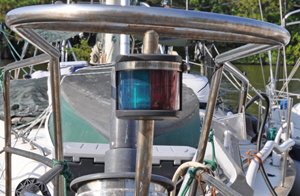 position.
There are lots of different makes of navigation lights, but before buying I first had to decide the best place to locate them and there are many different ways to mount them as well. One is to use a combined port and starboard lamp mounted centrally on the front of the pulpit rail. Another is to use the combination type lamp is at the masthead, that usually also encompasses a white stern light and which at least they can be seen. Both combination types tend to be used on smaller craft to save electricity by using a single bulb. Another method is to have separate lamps mounted on either side of the pulpit rail but I have experienced problems with pulpit locations during tacking a jib when flaying sheets would sometimes, (or rather always!) snag under the lamp body and one time the lamp was completely wrenched off its mount!
 decided to buy a set of three individual Aqua-signal series 41 lamps that have Fresnel lenses with a minimum visibility of two nautical miles when fitted with the 25-watt bulbs, which are supplied. I wanted to set them as wide apart and as high as possible to be easily visible in all conditions. Initially I thought a good place would be on the end of each of my forward pin rails that carry the belaying pins. These are nearly as wide as Britannia's beam and eight feet above the waterline. The only problem I found with this location was the lamps would be dead in line with the jib sheets when close-hauled and having intimate knowledge of Murphy's Law, the sheets would be certain to become entangled with the lamps the very first time we tacked. I finally decided to mount them each forward corner of the saloon coachroof, this being the highest point on the deck and unobscured in all directions. It was also clear of any running rigging and about seven feet above the waterline.
 These lamps are very robust and designed as self-standing units but I still wanted to protect them a little from being accidentally knocked by anyone on the upper deck. The deck also slopped slightly so I made solid teak bases and chamfered the bottom, thus allowing the lamps to sit vertically. They were then varnished, caulked and screwed down into the deck and the lamps screwed to the bases.
This done the next thing was to provide a 12-volt supply to the lamps. The positive wire to the existing lights came off a contact breaker on the master distribution panel, but only one positive wire went forward to the port-light then around the bow to the starboard light. This meant that if there was a short circuit anywhere both lights would fail, I therefore wanted independent wiring to each lamp. So using the old wire as a pull-through I pulled two new 14 AWG wires through from the breaker, one for positive and the other for the return from the port light. I then ran two new wires from the same breaker under the floorboards and along the saloon side to the starboard lamp. Both negatives returned to the negative bus bar on the panel. This made the lamps indipendent of each other in the event of a bulb failure.
 I had to remove the ceiling panels of the saloon headliner under where the lamp was mounted to feed the wires up through a hole I had drilled in the lamp mounts and through the deck. Connecting the wires was easy and at this point I also exchanged the 25-watt incandescent bulbs for new LED bulbs. The HQRP BAY15d LED bulbs consume less than one watt at 12-volts.
 I mounted the stern white light on the end of one of the davits eight feet above the water and used the old wire to pull new cables through to the breaker. I then removed the original lights from the bow and pulled all the old surplus wire out of the boat. I sealed the old screw holes with a resin filler and after a touch of white paint nobody will ever know they had been there
Before I removed the old light I took a photograph of the lights at night. The comparison with the new lamp with its LED bulb is astonishing! It is difficult to believe the new lamps use slightly less power than the old ones and that's what I call progress.