A member of our yacht club inflated his 10-foot Mercury RIB using a regular gas compressor that is normally no problem - except that he forgot to reduce the pressure after using it to inflate a tire and it blew both end covers clean off both side chambers. He didn’t know how to repair it and he he gave it to me to see if I could do it. Strangely the bow chamber remained inflated and never deflated.
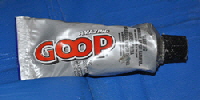 The two circular rigid plastic end caps had to be glued back on the end of each chamber which was quite tricky because the ends of the tubes were floppy PVC material. Wearing rubber gloves I smeared liberal amounts of goop glue on the inside of the chamber ends then I wangled the end caps inside the ends of the tubes and secured them all round with duct tape while the glue set. I just hoped I had put enough glue on the join to not only secure it but also seal it when inflated. Goop is ideal for this type of work because when it dries it remains quite flexible and adjusting to pressure changes and flexing in a rubber boat.
 Well, I achieved the first objective but not the second.
After three days of allowing the glue set hard I inflated both chambers to only 4psi the recommended pressure and the end caps never moved, but air was seeping out in a few places through the joins. So over the next few days I tried to seal the leaks using Goop on the outside of the chamber but as soon as one leak was plugged another would break free from the next weakest point. It was a slow tedious process and I wasn’t making much progress at all.
Jim Hampson, a sailing pal suggested that I pour expandable foam into each chamber and let it fall to the bottom where hopefully it would expand and seal the leaks from the inside. I had never used this type of foam and had my doubts but willing to give it a try. I bought the two-part mixture called closed-cell polyurethane flotation foam from Jamestown Distributors for $55.00 for a 2 quart pack.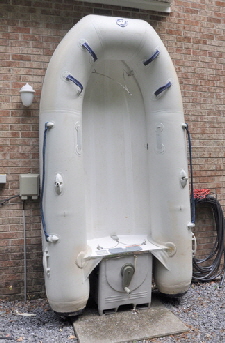
This is when the fun started:
Jim and I propped the dink’ upright against the house wall by resting the transom on a strong water hose holder so the bottom of the chambers remained clear of the ground. The instructions said that the two liquids should be mixed 50-50 and thoroughly stirred in a plastic container then poured within about two minutes
 We also didn’t know how much the liquid would expand inside the chambers so we decided to first do a test with a small amount. The water-like liquid was easily mixed in a plastic vessel and we waited to see what would happen next. There was only about half an inch of liquid in the container but it quickly started to expand until it popped out of the top like a freshly baked loaf. It had expanded about 20 times its original capacity and was rigid in the container. This gave us a rough idea of how much to mix to fill the bottom of each chamber.
The next decision was where to cut a slit in the material to be able to stick a long funnel inside. This needed to be well above where we thought the expansion would end so Jim made the incision with a box-cutter and I waggled the funnel inside until it was roughly half-way inside the chamber.
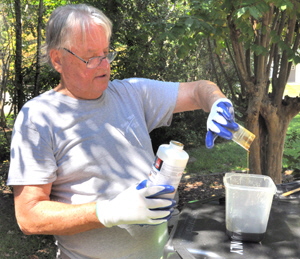
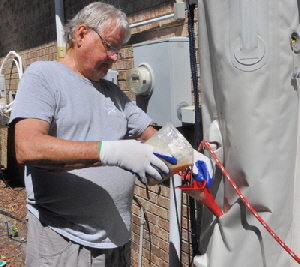 Jim mixed eight times more than we had used in our test and stirred it thoroughly. Then he just poured it through the funnel and we heard it splatter onto the dinghy end plate below. We tried this on the port-side chamber first just to see if it would seal the leaks.
We could feel roughly how much it was expanding because the sides of the dinghy became warm and the process seemed to stop at about six inches from the bottom. We obviously couldn’t inflate the chamber because of the slit in the side’ so I sealed that with Goop glue and left it overnight in the hope the glue would effectively seal the incision at least temporarily.
It was with some trepidation that I connected my electric pump to the air valve the next day and watched as it slowly expanded the camber. The pump gauge finally showed 3.5psi and I switched it off. I then did a soap and water test on the incision which showed no air bubbles so we just had to wait patiently to see if the camber itself would hold pressure.
The next morning I was amazed to see the chamber still fully inflated – Wow! What a relief after so many long hours messing about trying to seal the ends from the outside. We had finally fixed the dink’ by bunging it up from the inside – who would have thought it! Over the next couple of days Jim and I sealed the starboard side chamber the same way and I glued two patches over the incisions to reinforce them and the job was done.
So another job has been crossed off my list – but there are still others, after all, Britannia is a boat…
HOW TO SEAL A DEFLATING DINGHY - WHEN ALL ELSE FAILES.
