

To change Britannia’s rig from a ketch to a brigantine schooner it was not only necessary to buy new standing rigging in the form of stainless steel wire, but to also rebuild and reroute the running rigging, i.e. all the ropes that operate the sails and booms, including in Britannia’s case the square sail and yard. I wanted all the control lines to return to the cockpit so nobody, (usually me), had to venture on deck in either inclement weather or rough seas.
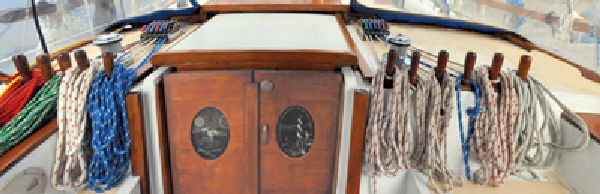 Roller furling certainly makes sail handling easier in that it is not necessary to pull the sails up and down every time you want to reef. But they also need more control lines and when you have five roller furling sails this can seem a bit complicated. Britannia’s cockpit has a wide empty area either side of the companionway that was previously used for only a couple of lines. I now have 12 lines all leading onto what we call “the rope decks”, along with a further five lines either side on the coamings to the winches.
CONTROL LINES:
The controlling lines are double braided polyester 3/8", 1/2" and 5/8-inch diameters, depending on their job. These ropes are exceptionally strong with very little stretch and nice and smooth on the hands. The main components of these are:
a.Five furling lines that roll sails in around their foils.
b.Three outhauls which unroll the sails – the opposite to the furling lines.
c.Two sheets that control the staysail booms.
d.A continuous furling line that rolls the squaresail up and down.
In addition to these lines there are five other sheets that come from the clews of the sails and lead into the cockpit through running blocks to their own winches mounted on the cockpit coamings. These are:
a)Two clew lines (sheets) from the Jib.
b)Two clew lines from the squaresail.
c)One clew line on the tweenmast staysail when it is detached from its boom.
RUNNING BLOCKS: These are roller-bearing pulleys that route lines along the deck and eventually to the cockpit. Britannia has a total of twenty-two blocks in singles, doubles and triple combinations. In addition to these “normal” pullies there a blocks that lead lines up and over the coach-roof and into the cockpit. I could not find suitable blocks to carry these lines up and over the coach roof into the cockpi, so I made my own. I made one single sheave, a double, a triple, and a row of six called up and over blocks
ROPE CLUTCHES:
These are clutches that allow lines to slide through, but when it is correctly tensioned on a winch, the lever is applied that locks the line, and it can be removed from the winch and coiled around a row of belaying pins on each side of the companionway, keeping the lines tidy yet for instant use if needed.
Not all lines need to be attended to at the same time of course and they are arranged so that each sail's lines are next to each other. Some of the sails need a lot of winch winding; for example it takes 19 turns to wind the fore course squaresail up into its yard. I therefore invested in an electric winch winder, a powerful right-angled electric device with an adapter that fits into the hole in the top of any of the seven cockpit winches. The motor is variable speed and also reversible so that a two-speed winch can be worked in the slower, but more powerful direction. This device effectively converts all our cockpit winches into electric winches and saves a lot of effort, and also much faster than hand-cranking. It can also be used on mast winches whenever a sail is needed to be lowered off its foil.
WINCHES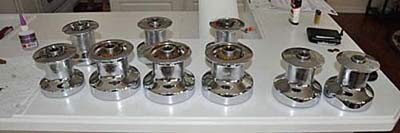 Some winches were seized very stiff when I bought the boat, and a few internal rachets were broken. They were all Lewmar makes so I bought spare parts and repaired them. I then had all the winches re-chromed, along with all other deck hardware that improved the appearance of the boat and ensured that all the equipment worked properly. All the sheet winches are reachable from the helm seat and all but the jib are self-tendering when tacking.
BELAYING PINS:
Belaying pins are the traditional way that lines were stowed on a ship because they are always ready for instant use. I turned 25 pins from Hickory wood on a lathe, than varnished them. Belaying pins are better than bags that are fitted on some modern sailboats to contain lines because lines are more quickly available when needed by just lifting them off the pin and are ready for use. When they get wet the lines dry out quicker and do not bunch up like in a bag. Identification is by using different colored lines and having all the rope clutches labeled, all part of how a fine ocean cruising yacht is managed.