
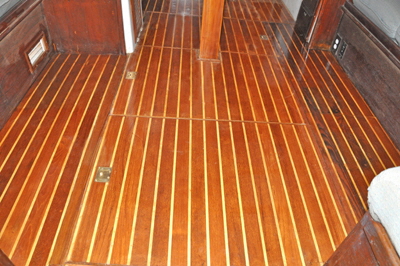
 I had spent a lot of time and effort to restore Britannia’s teak and holly sole to its original glory throughout the whole boat, but this had made no difference to the noise level from all the machinery below the saloon floor. When the main engine and the generator diesel and heat extractor blowers were running it was very noisy in the saloon with a dull drumming you could almost touch. So I decided to do something about it
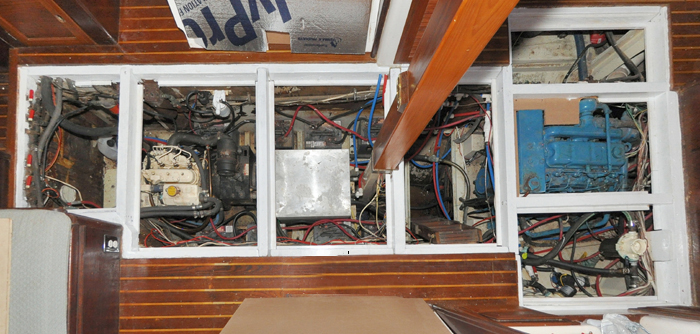
Britannia's engine is the tried and trusted—but noisy Perkins 4-236 85hp four-cylinder diesel. The generator has a Kubota three-cylinder diesel and along with five electric pumps and two bilge air extractor blowers, all under the same floorboards it can get very noisy indeed. I call the space the “equipment bay” and it runs 12-feet all the length of the saloon. The space is 3-feet wide at the floorboards and 4½-feet deep down to the bilge. Seven removable floorboards give amazing access to all the equipment below but the large space also acts as a massive boom-box.
There are a lot of products that claim to significantly reduce noise from machinery and some of which are specifically aimed at boaters. The trouble with most of these is they are also specifically aimed at boaters bank balances! I found prices for my boat’e size from $350 for simple 3/4-inch foam to $1000 plus for double thickness sound insulation sandwiches.
In simple terms the object is for the material to absorb sound waves from the noise source and minimize what filters through the floor into the saloon. It would be practically impossible to eliminate noise completely but I had effectively reduced the engine noise from a Perkins 4-236 on a previous boat, simply by installing a false floor beneath the cabin sole. This is quite an easy and inexpensive do-it-yourself way to achieve a significant sound reduction. I decided to repeat the operation on Britannia but with an additional element.
 Before staring I wanted to take a reading of the sound levels to have a numerical comparison after the modifications were complete. I downloaded an app' of a neat little decibel meter by DB Meter Pro into my I-phone for the vast sum of $0.99 from the iTunes app store. It is very easy to use and I took readings at head height in the center of the saloon. The first was with the main engine running at cruising revs thatregistered 85 decibels. Then I started the generator along with the twin extractor fans. The level went up to 93 decibels that is roughly equivalent to a power lawnmower. When the freshwater pump was activated it added another few decibels. I don't know how accurate these readings actually are but what I wanted was a comparison between before and after the modifications I was about to do.
A FALSE FLOOR
Firstly it was necessary to make support battens for the false floor panels to lay in under the existing plywood sole. I bought a 24-inch by 48-inch sheet of 1/2- inch plywood and cut it into 4-inch wide strips with my table saw. I also made 3/4-inch square battens out of hardwood. It was also necessary to reposition some pieces of equipment that were fastened to the sides of the floor beam, like wire cable hangers, water pipes and the big main engine filter. All had to be lowered below the floor beam level. The 4-inch wide plywood strips were then screwed to the underneath of the 2-inch wide floor bearers to form a 1-inch lip on either side. I screwed the 3/4-inch square battens to the sides of each compartment to support the ends of the false floors. This framework then supported the boards all around and I painted the bearers and new timber white.
 I found some Medium Density Fiberboard (MDF) in 8-foot by 4-foot sheets 1/2-inch thick. MDF is a heavy manufactured board similar to particle board but smooth on both sides and a density of 44Lbs per cubic foot. It is used to make stereo speaker boxes and other things where sound control is required. The sound deadening properties of this 1/2-inch thick board are better than the 3/4-inch thick marine plywood floorboards themselves that are roughly 35Lbs per cubic foot. These boards are also available in 3/4-inch thickness, but would have been half as heavy again, so I decided to compromise between weight, density and price with the 1/2-inch board.
A problem to be aware of with these types of manufactured boards is their susceptibility to deterioration in damp conditions. If there is a chance they might become wet it would be better to use marine plywood but this is much more expensive. The hardware store assistant cut these heavy sheets to the sizes I needed with their vertical circular saw that enabled them to fit in my vehicle. I had them cut 1/2-inch smaller than the spaces between the individual beams to prevent them from jamming when I needed to lift them out. A few boards still needed trimming to fit around obstructions which I could not reposition but easy with my jigsaw.
 The simplest method to handle boards which need to be removed from apertures is to cut a hole in the board big enough to get a couple of fingers through to lift it in and out. But these MDF boards were too big and heavy for that and it would also have allowed a little bit more noise and heat to escape. I therefore drilled 3/8-inch holes in each board and threaded some 3/8-inch diameter rope through, knotting it on the underneath to form simple handles to easily lift the boards in and out
The combined weight of all the fiberboards was 60Lbs but they are all positioned low down in the hull and a small weight increase for reducing the noise and their weight also keeps them firmly in place. The floorboards and the false panels had a combined thickness of 1¼-inches with a density of about 80lbs per cubic foot.
The section around the Perkins engine was particularly awkward because parts of the top of the engine were higher than the bottom of the beams and the valve cover was only 1-inch below the floorboards. This was of course the highest source of all the noise, so it needed special attention. I fitted battens all around the engine like all the other openings then shaped pieces of fiberboard to fit around the engine.
HEAT INSULATION
 Although the sound was significantly reduced, heat could often be felt permeating through the floor when either of the diesel engines had been running a long time. I therefore decided to add a layer of thermal insulation in the space between the boards to reduce the heat coming through. I bought two 4-foot by 8-foot sheets of Rmax Thermasheath R6 foam insulation board that are 2-inch thick with aluminum foil on one face and an insulation rating of R6, the highest available for this thickness of foam. I cut them to the different sizes myself at the store using a sharp knife to enable them to fit in my car. I then glued them to the underneath of each floorboard using construction adhesive by Liquid Nails that does not melt the foam.
The floor now had the 3/4-inch plywood floorboards with 2-inches of foam glued underneath, then a half inch air gap, then the 1/2-inch MDF false floor. It was certainly a compact floor.
I cut pieces of insulation to the size of the engine apertures and pressed the foam down over the raised engine by actually standing on them with the fiberboard on top. This indented the soft foam with an exact pattern of the high points of the engine which I then hollowed out of the foam with a sharp blade. After scooping out all the high areas I glued the foam to the fiberboard that then fitted snugly under the floorboard giving an added layer of fiberboard over the motor plus foam insulation.
After all this back-aching work I was naturally keen to take new readings on the decibel meter. With only the main engine running with the same revs' the meter recorded 65dB, a reduction of 20 decibels! Adding the generator raised this to 70dB, 23 decibels less than before and about equivalent to an electric sewing machine. Decibel ratings are logarithmic so the noise reduction is very noticeable and we can comfortably listen to the TV or music at anchor even with the gennerator running.
In addition to a considerable reduction in noise there is now no heat coming through the floorboards that keeps the living areas cooler. Heat is all carried outside by the engine room extractor fans the noise from which is also much reduced
Most projects I have undertaken on Britannia have resulted in visible improvements, most notably when I renovated the actual teak and holly floorboards. But this noise and heat abatement project showed no visible improvements and the cabin looked exactly the same as before I started the job. It was only when the engines were running that the improvement was really appreciated.
This method of sound insulation would be very worthwhile for any boat, offering excellent noise reduction for minimal financial outlay. I even used some spare pieces of MDF to double the wall thickness in the spaces where my two air conditioning units were installed reducing the noise of the compressor and fan.